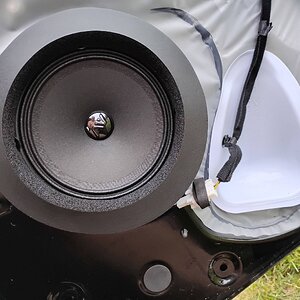
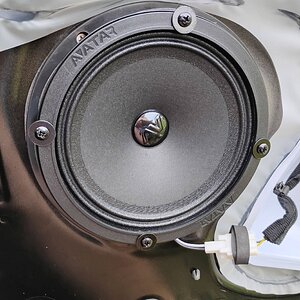
Again, let me sidetrack; [warning, I'm not a guru on this topic, I'm using the common sense card in my back pocket]
Read this;
http://audioalloy.com/h01-00_tips.html
5 points of isolation.
1. Mass
2. Mechanical de-coupling, or mechanical isolation.
3. Absorption
4. Resonance
5. Conduction
This is in reference to HT construction, but some applies to speaker box building.
1. Mass
You need mass for woofers otherwise imagine making boxes out of thin cardboard, won't work well. You don't want the walls of your speaker box to
flex.
2. Mechanical de-coupling, or mechanical isolation.
This is where I'm not so convinced in terms of speakers. Some esoteric builders
like to place some material between two [or more] sheets of wood to make
an isolation layer, could be rubber, etc. I've tried this and it does decouple one
piece of wood from aonther but you have a similar resonant frequency as the single layer of wood. In other words, for sound proofing it's cool, but for speaker box building are we sound proofing or trying to make the box have less resonance by adding more mass? Not having that isolation between wood will
lower resonance.
3. Absorption
This is what you want for those [open back] midwoofer/midrange drivers, the sound from the speaker inside the box to be absorbed so there is no standing wave coloration.
4. Resonance
You really don't want your box to resonate badly as this sound add
coloration. You can add mass to lower resonance.
5. Conduction
I don't know how this would apply to speakers ATM.
So.. we have mass and aborption as probably the bigger factors [there is stiffness too]. We get mass
by using heavy materials like MDF over plywood unless you want to use plywood
that is 'thicker'. If you made a speaker box out of thin sheetmetal then you may have
less mass and obviously, you can have a higher resonance. So we use dynamat
inside this metal box to dampen it, to lower resonance, but it doesn't add much mass -> how heavy is dynamat in relation to a hunk of wood? not heavy at all.
On the other hand, there is thicker mass loaded vinyl 1/8" that is 1 pound per sq. ft. 1/4" thick is 2 pounds per sq. ft., dynamat is typically 30 mils thick, 4x thinner than 1/8" MLV. some of the uber dynmat is still 1/2 the thickness of 1/8" MLV.
Since MLV isn't cheap, we still opt to make our boxes out of wood because it's
cheap mass for the money, ~ 3/4" MDF is about 3 pounds per sq. ft.
But, three layers of 1/4" MLV to equal 3/4" MDF has 2X more mass than
3/4" MDF, ~ 6 pounds per sq. ft. But we can't make our boxes out of this because
it's not stiff like wood.
After we figured out mass for your speaker project you have to figure out the
absorption, those waves that bounce around those walls that have high mass.
You need 'space' for these waves to get 'buried' into to dissipate into heat.
If you were to take 3" thick fiberglass and compress it into a paper thin material,
you no longer have the same absorption characteristics, rather you have paper
thin material with mass. You changed your material from absortion type of
material to a mass only material. In other words, I don't think you can cheat
by compressing the material so much that it doesn't function anymore as intended.
I don't have a scientific explaination on how it works but I guess you can visualize
'quicksand' as a simple analogy. You walk on the ground which has mass, then
you step in quicksand and fall into it, can't get out {fiberglass}. If you remove
the water from the quicksand, you have only sand, you won't easily fall into it.
When you want to replace your fiberglass filled TL box with a denser 'white foam',
the sound waves will see sand, not quicksand //content.invisioncic.com/y282845/emoticons/crazy.gif.c13912c32de98515d3142759a824dae7.gif and not function properly.
//content.invisioncic.com/y282845/emoticons/crazy.gif.c13912c32de98515d3142759a824dae7.gif