


Calc 2 Question

RKPsk8er
10+ year member

CarAudio.com Elite
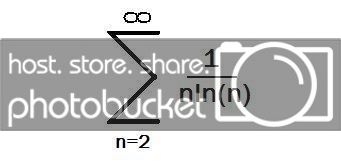
This is the problem. I need to know if it converges or diverges using the integral test. I don't know how to integrate this. My guess is a u substitution of ln(n).

cal2-1.jpg


This is the problem. I need to know if it converges or diverges using the integral test. I don't know how to integrate this. My guess is a u substitution of ln(n).
cal2-1.jpg
Don't post shit like that OP! You'll scare the CA kiddies!!! //content.invisioncic.com/y282845/emoticons/eek.gif.771b7a90cf45cabdc554ff1121c21c4a.gif

 
converges to zero according to maple. It is also showing 1/n*ln(n)....as being the same as ln(n)/n. I just used a limit to get this answer not the integral test. I'm not sure how to do it that way. Wouldn't this be an inproper integral since the upper bound is infinity? If so the integral is going to become a limit anyways.

 
I don't remember this stuff real well, and don't feel like looking up the log rules but you might try splitting it (1/n) * (1/ln(n)) and working from there.
I set u = to ln(n)

du=1/n dn

that gave me integral(1/u)du

that came out to ln(ln(n)) 2 to infinity or t once you switch the improper integral to a limit.

does that look okay?

 
the integral test works if the series is positive, continuous and decreasing. It looks like all that is true, and my proffesor asked us to solve using the integral test so I'd assume so. Basically if the integral of An converges/diverges, so does the series. I'll put a pic of my work for someone to check.

 
Activity
No one is currently typing a reply...

About this thread

RKPsk8er

10+ year member
CarAudio.com Elite
Thread starter
RKPsk8er
Joined
Location
ATL
Start date
Participants
Who Replied
Replies
23
Views
502
Last reply date
Last reply from
RKPsk8er
IMG_20260516_193114554_HDR.jpg

sherbanater

    May 16, 2026
  • 0
  • 0
IMG_20260516_192955471_HDR.jpg

sherbanater

    May 16, 2026
  • 0
  • 0

New threads

Top

